What I’ve Begun to Notice by Living with a Classical Guitar
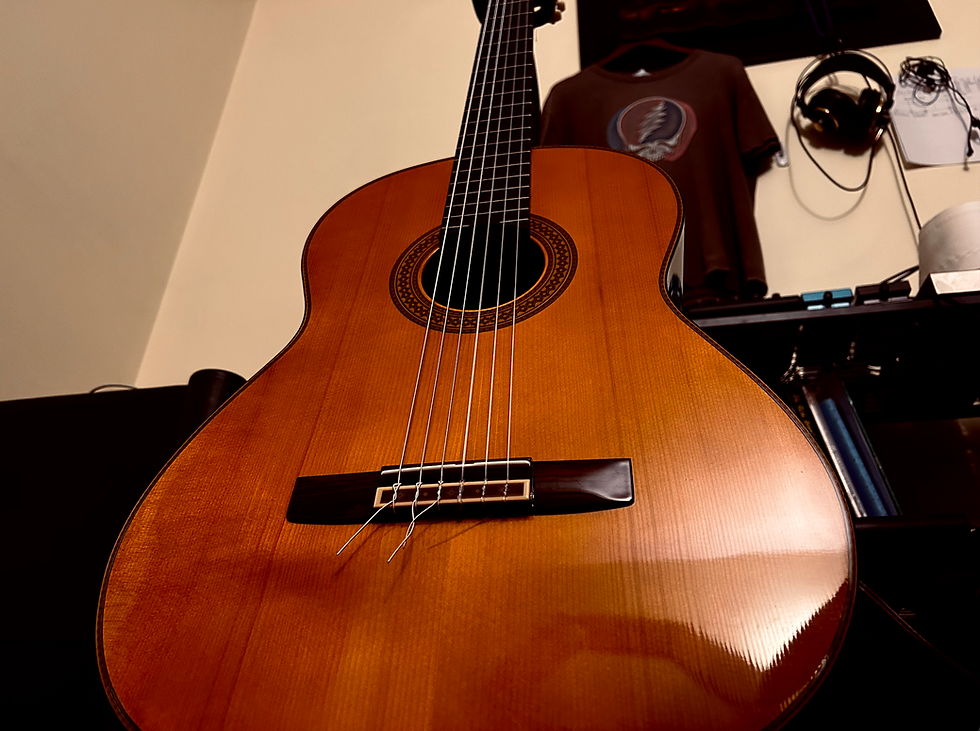
A friend entrusted me with a classical guitar that had clearly been deeply cared for.
I could probably say it was “given to me,” but I still do not feel fully comfortable putting it that strongly.
For now, what feels more honest is that something precious has been placed in my hands for a while, and that I am being allowed to spend time with it carefully.
I have spent many years with steel-string acoustics, archtops, and electric guitars, but this is the first time I have had a classical guitar in my daily life in a way that lets me observe it closely over time.
Of course, this was not the first classical guitar I had ever touched. But it was the first time one entered my life as something to live with—something whose quirks, response, surface condition, and small day-to-day changes I could actually notice.
So at first, I only had a vague image of what a classical guitar was supposed to be.
A certain sound, a certain feel, a certain world. I had that outline in my head, but it still belonged more to memory and language than to lived experience.
The first surprise was how easy the neck felt.
Some classical guitars make me brace a little the moment I pick them up—the width, the shape, the way they ask the left hand to approach them. But this guitar did not have that kind of resistance. My hand settled naturally. Positions felt unforced. It had the dimensions of a classical guitar, yet it fit the hand in a strangely immediate way.
And after a few hours of playing, another feeling began to emerge.
It felt as if the guitar itself was slowly waking up. Not in a dramatic or flashy way. More like something opening its eyes little by little after a long sleep.
At the same time, there were also things that bothered me.
The B string, in particular, had a kind of spike at certain frequencies. The overtone field as a whole felt cloudy, and the sound did not yet feel gathered. And yet, behind that cloudiness, I could already sense that the guitar was capable of much more.
Was that simply the instrument’s character? Or was it the result of strings that had been left on for too long?
At that point I could not tell. But I could already feel that the guitar’s real voice was not fully present in the sound I was hearing.
That was where the observation began.
Changing strings. Cleaning the surface. Watching how light moved across the top. Listening to the attack, and to the way notes disappeared.
There was far more to notice than I had expected, and the discoveries were very different from the ones I usually make with steel-string guitars.
A classical guitar turned out to be, more than I expected, an instrument of knots.
What struck me most during restringing was not just that the method was different, but that the sound kept changing for quite a while afterward.
The strings did not feel fully settled the moment they were installed. As the tuning kept dropping and I brought it back up again, the bridge knots, the windings at the headstock, and the seating points at the nut and saddle all seemed to tighten into place little by little.
And as that happened, the sound also began to gather itself. Not just the pitch, but the attack, the overtone structure, and the decay all started to feel more coherent.
It felt as though the strings were moving from merely being attached to the instrument toward actually becoming part of it.
That process was much more audible and tangible than I had expected.
Another thing that surprised me was how much cleaning changed the sound.
At first, I thought of it simply as maintenance.
I carefully wiped the body and polished the fingerboard one fret at a time. But as I went on, it began to feel like more than cosmetic care.
The biggest change came from the top.
After carefully polishing the soundboard, the resonance changed quite noticeably. The attack became clearer, but at the same time the sound also gained more roundness. It was not simply brighter. The attack became more defined while also taking on a darker kind of shading. The result was that the guitar moved closer to what I had imagined a classical guitar should sound like.
When I looked at the cloth afterward, it had collected a surprising amount of grime.
Seeing that, I found myself imagining that this guitar had not spent those years hidden away in its case, but resting somewhere visible, quietly becoming part of a room’s landscape.
Over time, a very thin layer of oils and dust must have settled across the top.
Once that layer was removed, not only the sound but also the behavior of reflected light began to change.
I had already suspected that the finish on this guitar was not especially thick. When light hit the top, it seemed to diffuse slightly along the grain of the spruce.
After cleaning, that impression became even stronger. The surface did not merely shine; the light seemed to return softened, as if it had passed through the direction of the grain itself.
Something similar seemed to be happening in the sound.
The tone was not simply bright, direct, and linear. It felt as though it passed through shadow first and then arrived softened.
Not dull—quite the opposite. Rather than light and sound being thrown back nakedly, they seemed to come through the time and grain beneath the surface, returning in a calmer form.
The strings themselves also led to a very clear discovery.
The first set I installed was a fairly standard set of clear nylon strings.
They had obvious strengths. The attack was excellent. Notes spoke easily even with very light force. Trills and small ornamental movements came together readily. The response to a light right-hand touch was fast, and while playing I could honestly think, “I see—this has its own kind of beauty.”
But after spending more time with them, my dissatisfaction also became clear.
What troubled me was less the tone color itself than the way the notes decayed.
Clear nylon is highly efficient in the way it speaks. But to my ears, that efficiency sounded a little too smooth, too polished. The notes lingered too evenly, too cleanly. The natural vanishing quality of a plucked instrument—the fragility, the shadow, the beauty in the way the note leaves—felt slightly reduced.
So it was not that I objected to sustain in itself.
It was that the decay did not seem to carry enough beauty within it.
If I wanted a smoother, more flowing direction—something that lets notes float with very little effort and a kind of linear smoothness—I can see why clear nylon would be appealing.
But if I were going to pursue that kind of sound, I would naturally do it on an archtop with flatwound strings. That musical idea feels more at home on that instrument to me.
So in the end, my conclusion about clear nylon was this:
The attack was good. The response was good. Trills were easy.
But what I was looking for from this classical guitar was not quite there.
Then I changed to rectified strings.
That turned out to be a very good decision.
The first thing I noticed was that the sustain settled in a very positive way.
Not that it simply became shorter. Rather, the notes no longer lingered in an even, extended way; they rose, took shape, and then disappeared naturally. There was beauty in the decay itself.
Instead of regretting the loss of the sound, I felt that the manner of its disappearance was itself beautiful. And I think that, for me, was exactly where the “classical” quality of the guitar truly lived.
Rectified strings are often described in general terms as “warm” or “round.”
But to my ears, that was not quite right. If anything, the clear nylon sounded rounder.
What I heard instead was something dark, deep, mysterious, cinematic.
Not brightly reflective, but as though the sound arrived only after passing through shadow.
If clear nylon reflects light directly, rectified strings seem to soften the light and return it with a trace of shadow.
And none of that is meant negatively.
The sound had shadow. It had depth. It had narrative.
It felt as though the true voice of a plucked instrument had finally come into view.
Through this whole process, my sense of my own string preferences also became much clearer.
For practical reasons, I have often used D’Addario.
The reasons are simple: easy to find anywhere, reliable consistency, good resistance to corrosion.
In that sense, D’Addario is an extremely dependable string brand.
But in terms of sound and touch, it has also become clear that my ear is drawn in a somewhat different direction.
D’Addario strings, to me, often have a smooth, polished, well-behaved quality.
What pulls me more strongly is something with a little resistance, some surface texture, some slight friction or fibrousness in the sound.
On acoustic guitar, I moved from D’Addario to monel.
On archtop, I use Thomastik.
On Stratocaster, I am still using leftover D’Addario 10–46 sets, but I already know I want to try something else next.
And now, with classical guitar, I found that rectified suited my ear more than clear nylon.
When I put those choices side by side, the direction is remarkably consistent.
Smooth versus textured.
Clean versus lived-in.
Well-behaved versus slightly earthy, in a good way.
And by “earthy,” I do not mean merely old, crude, or lo-fi.
What I seem to love is something that still has elegance, but has not been over-polished. Something that still retains tactility and life. Something whose texture contributes directly to its expression and shadow.
I am more drawn to sounds that contain a little shadow and resistance than to sounds polished into lifeless perfection.
Another thing this experience made newly clear is that I really do prefer using tools in a differentiated way.
Any guitar can play notes.
Any set of strings can produce sound.
But that is not enough for me.
I think instruments carry roles.
What I do on an archtop is different.
What I do on a dreadnought is different.
What I do on a classical guitar is different.
And because those roles differ, the distinction between tools matters.
I do not think I am searching for one instrument that can do everything.
What I value more is an instrument whose role is clearly defined.
That clarity changes the ear, the body, the state of mind.
It is not only a matter of performance differences. The tool itself teaches me what I am doing.
In that sense, this classical guitar is not a substitute for my other guitars.
It is becoming, instead, an instrument that reveals things that the others do not.
I think it is still too early to draw final conclusions about it.
The strings, the right-hand approach, the surface condition—these will probably all continue to change.
Even so, in a short period of time, this instrument has already taught me a great deal.
That string material and surface treatment do not merely alter tone color, but change the meaning of decay itself.
That the layer of dust and the way light reflects from a surface can affect how sound is perceived.
And that what makes a classical guitar “classical” is not simply softness or gentleness, but the whole shape of a note rising, being softened, passing through shadow, and disappearing naturally.
For now, I still feel closer to saying that I am being allowed to spend time with this guitar than that I “own” it outright.
But within that time, this instrument has already taught me a great deal about strings, decay, surface, light, shadow, and the role of tools.
I hope to begin writing songs with it as well.
It does not feel so much as though I have acquired something, but rather as though I have quietly been entrusted with a role.
So I want to take my time, avoid exaggeration, and continue turning that observation into sound, little by little.